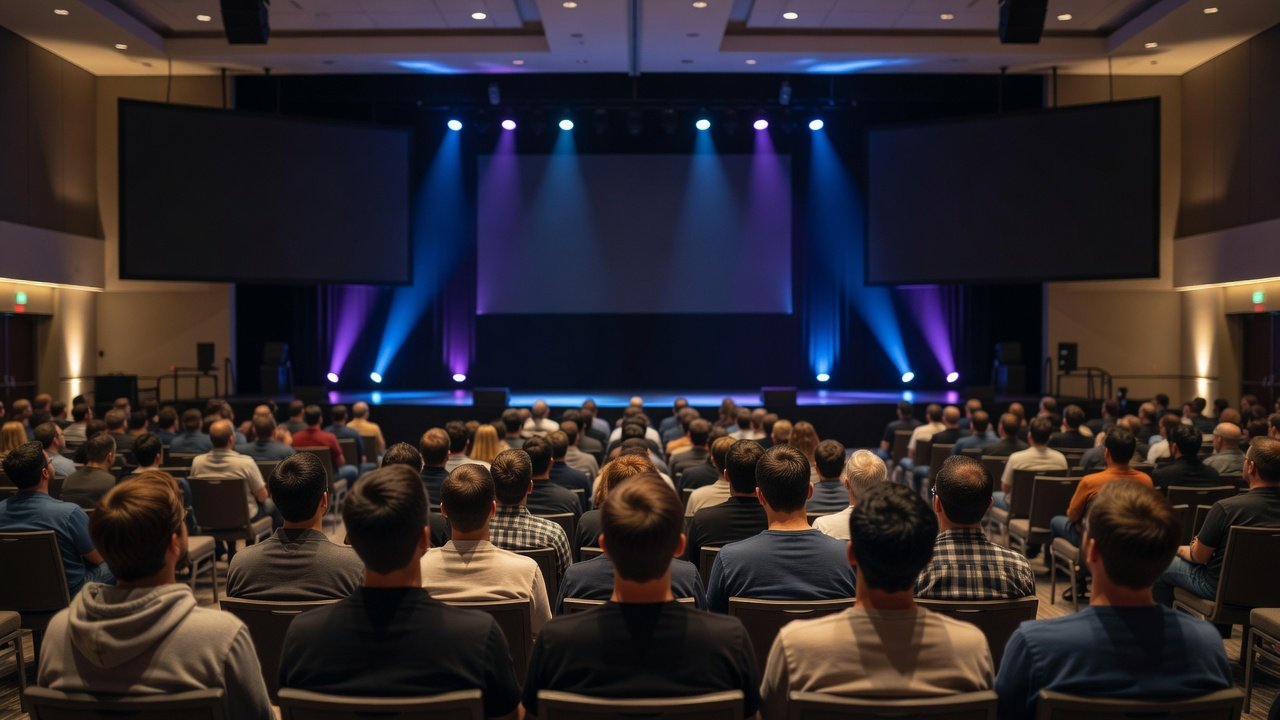
GitHub Universe returns to Fort Mason Center in San Francisco on October 28 and 29, 2026, with an online option for people who do not travel. The theme is “All together now, in the agentic era.” Conference themes are marketing by default, but this year the published schedule gives engineering leaders something more useful than a keynote teaser: a list of the operational questions GitHub expects customers to be asking.
This preview sticks to what GitHub has published about the event and about last year’s announcements. It does not predict launches. Nobody outside GitHub knows what will be announced on stage, and a leader’s planning should not hinge on a rumor.
What the schedule actually emphasizes
GitHub’s schedule announcement groups sessions into three tracks, and the topics named in each are a useful map of where the platform’s attention is.
Find Your Flow is the hands-on track. Named topics include Copilot configuration and delegation strategies, optimizing a coding harness across different AI models, and workflows built around stacked pull requests. The pairing is telling. Delegating work to agents increases the number of pull requests a team handles, and stacked pull requests are one way to keep many small changes reviewable.
Find Your People covers community and adoption, including enterprise AI adoption at scale, open source practice, and Copilot CLI demos.
Build What’s Next is forward-looking. Listed items include an AI-assisted development roadmap panel with Anthropic and OpenAI representatives, fine-grained authorization for MCP servers, and agentic pipelines at enterprise scale. GitHub also lets community voting pick one additional main-stage session.
Two details are worth noting for budgeting. There is a separate Day of Learning at GitHub headquarters, offered as a paid add-on that includes a certification exam voucher. Check the official event page for current pricing, since early-bird rates have already ended.
Last year’s announcements are the real baseline
Whatever is announced this October will land on top of what GitHub introduced at Universe 2025. The Agent HQ announcement is the context to understand first, because it set the vocabulary.
GitHub described Agent HQ as a way to orchestrate multiple agents inside the existing workflow. Coding agents from Anthropic, OpenAI, Google, Cognition, and xAI were to become available through a paid Copilot subscription. A “mission control” view was described as a single place, reachable from GitHub, VS Code, mobile, and the CLI, to assign, monitor, and manage agent tasks in parallel. Plan Mode in VS Code, source-controlled AGENTS.md files for agent behavior rules, and a GitHub MCP Registry rounded out the developer-facing pieces.
For leaders, the governance items matter more than the agent list:
- GitHub Code Quality, announced in public preview, gives organization-wide visibility into maintainability, reliability, and test coverage.
- A Copilot metrics dashboard, also in public preview, reports usage across an organization.
- An Agent Control Plane, in public preview, covers enterprise security policies, audit logging, and model access.
Preview status in October 2025 says nothing about maturity today. Before the conference, check which of these have since reached general availability, and in what form. That check turns keynote noise into a clear yes or no.
Five questions to bring to the sessions
The schedule is broad, so go with questions rather than a viewing list.
1. Where does review capacity go? More agent output means more code to read. The 2025 DORA report on AI-assisted software development, drawing on survey responses from nearly 5,000 technology professionals, describes AI as an amplifier of whatever an organization already is: it magnifies strengths and dysfunction alike. A team with a slow, overloaded review process will feel the pressure first. Sessions on stacked pull requests and delegation are worth attending for this reason.
2. What identity does an agent have? An agent that opens branches and pull requests needs scoped credentials, an audit trail, and branch protections that treat it differently from a human contributor. Ask presenters what their agents can push to, who is accountable for an agent-authored merge, and how that shows up in logs.
3. How are MCP servers authorized? Fine-grained authorization for MCP servers has its own listed session. If your teams are connecting agents to internal tools, the question of which tool calls an agent may make, on whose behalf, is a security design problem and not a configuration detail.
4. What gets measured, and by whom? Usage dashboards show adoption, not value. Ask whether any session connects agent usage to delivery outcomes such as lead time, change failure rate, or incident volume. If speakers cite productivity numbers, ask how they were measured and over what period.
5. What stays tool-neutral? The Anthropic and OpenAI panel is a signal that the platform intends to host several vendors’ agents. That helps with lock-in, but only if your conventions, such as agent instruction files, test suites, and CI checks, live in the repository rather than inside a vendor console.
Preparing before you go
A few inexpensive steps make the two days more productive:
- Write down your current review turnaround and the number of open pull requests per engineer. Without a baseline, agent claims cannot be tested against your own numbers.
- Inventory where agents already touch your repositories, officially or not. Shadow adoption is common, and the identity question above is easier to answer with a list in hand.
- Decide who owns the policy for agent-authored changes. If the answer is nobody, that is the first agenda item for the week after the conference.
- Plan to watch sessions on demand if you cannot attend live, and assign each attendee a single question to bring back to the team.
What to do with the announcements afterward
Treat launches as hypotheses. A feature announced on stage should earn a place in your workflow by passing a small pilot with a defined success measure: faster reviews, fewer reverted changes, or fewer escaped defects. Anything that cannot be measured against your baseline stays on the watch list.
The most durable takeaway from last year’s Agent HQ pitch and this year’s schedule is the same: agents are becoming a normal participant in the repository, and the work that matters is the surrounding system of review, identity, policy, and measurement. Leaders who arrive in San Francisco with their own baselines and questions will get more from the keynotes than those hoping to be told what to adopt.